
Fundamentals of nanoscale Liquid Chromatography
Miniaturization of Liquid Chromatography goes back to the mid-1960s with slurry-packed capillary or microbore columns, having inner diameters between 0.2 and 1 mm.[1] The reduction of the column internal diameter is paramount for improved chromatographic performance and sensitivity, based on the Van Deemter equation, which describes the efficiency of chromatographic columns in terms of the Hight Equivalent of a Theoretical Plate (HETP):
HETP = A + B/u + C∙u
where:
A is the Eddy diffusion term, related to multiple flow paths through the column;
B is the longitudinal diffusion term, representing the diffusion of analytes along the column;
C is the mass transfer term, accounting for the resistance to mass transfer between the mobile and stationary phases;
u is the linear velocity of the mobile phase, expressed in mm·sec-1.
The optimal flow rate of the mobile phase in a chromatographic system is found at the minimum point of the Van Deemter curve, where the combined effects of Eddy diffusion, longitudinal diffusion and mass transfer result in the lowest Hight Equivalent of a Theoretical Plate (HETP).
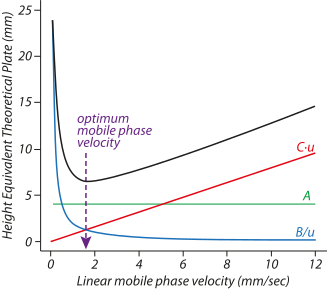
This is where the maximum number of plates is achieved for a separation column and hence, the efficiency of the column is at its highest. Reducing the internal diameter of a liquid chromatographic column impacts the Van Deemter equation in several ways:
- reduced Eddy diffusion (A-term): smaller internal diameters lead to more uniform packing and fewer multiple flow paths, reducing Eddy diffusion. This results in a lower term, improving column efficiency;
- decreased longitudinal diffusion (B-term): the smaller column dimensions reduce the distance over which longitudinal diffusion can occur, leading to a lower B-term. This enhances separation efficiency, especially at low flow rates;
- improved mass transfer (C-term): smaller internal diameters often come with smaller particle sizes, which enhance mass transfer between the mobile and stationary phases. This reduces the C-term, allowing for better separation at higher flow rates.
- increased sensitivity: separation columns with smaller IDs, require a decrease in volumetric flow rate of the mobile phase, equal to the square of the column ID-reduction factor, to maintain the optimal linear flow rate. This results in a smaller elution volume of an analyte, thus leading to improved sensitivity.
Overall, reducing the internal diameter of a liquid chromatographic column leads to improved column efficiency and higher sensitivity. However, maintaining the chromatographic integrity in nanoscale LC is challenging in terms of technical requirements:
- The LC pump must be capable of delivering a linear gradient to achieve an optimal mobile phase flow rate of less than 100 nL/min for the separation column
- The LC system should accommodate sample injection volumes in the typical range of 1-50 µL, while maintaining the optimal mobile phase flow rate of <100 nL/min
- The detection system — such as an Electrospray Ionization (ESI) interface coupled with Mass Spectrometry (MS ) — must be designed to avoid peak broadening, preserving chromatographic resolution
These technical challenges were successfully addressed in our Deans Column Switching System, developed in the late 1990s and showcased at the 49th Annual Conference of the American Society for Mass Spectrometry in Chicago, Illinois (USA) in 2001. This Deans Column Switching System has been described in detail by Meiring et al.[2]
- C.G. Horvath et al. (1967). Fast liquid chromatography. Investigation of operating parameters and the separation of nucleotides on pellicular ion exchangers, Analytical Chemistry, 39(12):1422-1428. DOI:10.1021/ac60256a003
- H.D. Meiring et al. (2002). Nanoscale LC-MS(n): technical design and applications to peptide and protein analysis, Journal of Separation Science, 25(9):557-68. DOI:10.1002/1615-9314(20020601)25:9<557::AID-JSSC557>3.0.CO;2-F
[Top]